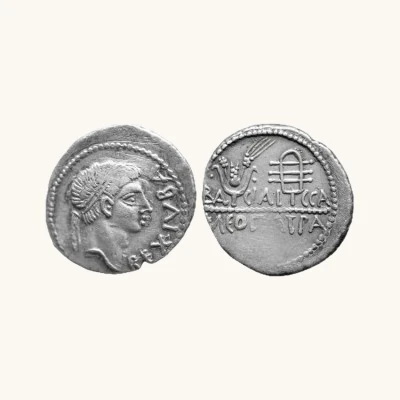
Carthage SNG Cop. 233-234 — with certificate of authenticity.
This Punic-period bronze attributed to Carthage, referenced as SNG Copenhagen 233-234, belongs to the typological group commonly defined by a head of Tanit facing left on the obverse and a plow facing left on the reverse, a group generally placed by specialist catalogues around 241 BC, with a classical attribution to Carthage in Zeugitana and, in part of the numismatic trade literature, a cautiously formulated hypothesis of a Sardinian mint. The present specimen, measuring 23 mm and weighing 6.41 g, fits this monetary category with remarkable precision through its module, weight, iconography and general manufacturing characteristics. Each coin is subject to detailed examination, rigorous description and the issue of a certificate of authenticity in keeping with the standards expected on the art and heritage market.
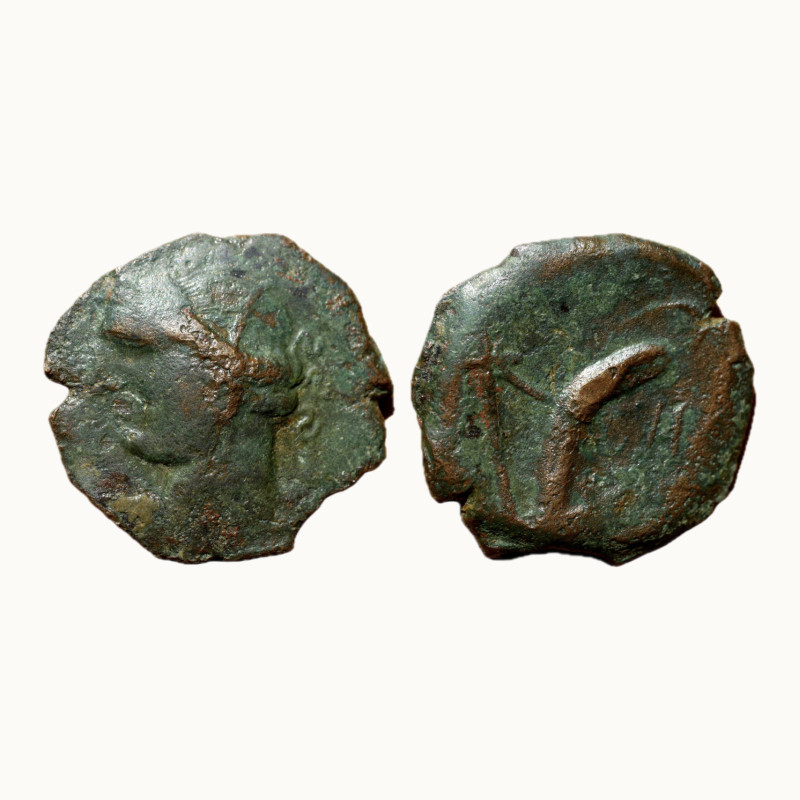
Careful observation under ×10 magnification with raking light. The obverse reveals a female profile facing left whose overall structure, despite pronounced wear and clearly visible ancient concretions, remains compatible with the classical Tanit type. The arrangement of the hair, line of the forehead, projection of the nose, form of the chin and volume of the neck are still discernible, while the edge of the flan shows ancient irregularity consistent with hammered striking on Punic bronze. The obverse as a whole is characterized by an old dark green and brown patina, punctuated by stabilized oxidation and compact areas, without total loss of the type. The canonical description attached to this reference is precisely Head of Tanit left / Plow left.
The reverse is the most decisive face for identification, since a plow facing left can be clearly distinguished, rendered by a share, upright and cross element in a simple yet legible manner. This motif, relatively unusual outside Punic coinage, gives the piece an immediate typological identity. Despite erosion of the relief and the irregularity of the flan, the agricultural emblem remains distinct enough to support the attribution without ambiguity, and even retains notable visual presence through the sobriety of its composition. Published comparison specimens for SNG Copenhagen 233-234 describe exactly this reverse as plow left.
The overall material examination reveals an ancient bronze with a well-established green-brown archaeological patina, softened but still perceptible reliefs, a strongly irregular flan, uncalibrated edges and a strike compatible with ancient hammered processes. Although the object does not display the sharpness of a high-grade specimen, it offers, by contrast, clear material authenticity, coherent surfaces and sufficient typological readability on both faces, all essential elements for a Punic bronze of this category. Numismatic reference descriptions accordingly qualify comparable Carthaginian bronzes as hammered pieces of round, irregular form.
This is a Punic bronze attributed to Carthage in Zeugitana, belonging to a group dated around 241 BC, with a Sardinian mint hypothesis sometimes mentioned cautiously in specialist literature. The obverse shows a head of Tanit facing left. The reverse shows a plow facing left. The principal reference is SNG Copenhagen 233-234. Measurements recorded for this specimen are 23 mm and 6.41 g. Published comparisons for the same reference include specimens of 21 mm / 7.02 g, 21 mm / 7.15 g, 21 mm / 8.04 g, as well as a commercial specimen of 23 mm / 6.41 g, placing the present coin firmly within a metrical range coherent with the type.
This type belongs to Carthaginian coinage from the closing phase of the First Punic War, a period in which bronze production, often more rudimentary in execution than precious-metal issues, nevertheless retained strong symbolic force through its types. The representation of Tanit, a major divinity in the Carthaginian pantheon, associated with a plow, an unusual agricultural emblem, forms an especially revealing iconographic combination within a Punic framework that is at once civic, territorial and religious. Specialist notices for SNG Copenhagen 233-234 regularly place this group around 241 BC and often mention a possible link with a Sardinian mint.
The historical interest of the plow lies precisely in the rarity of such a motif within the major Mediterranean monetary traditions. It symbolizes agricultural labor, agrarian order and territorial rootedness, clearly distinguishing this series from more common Punic bronzes decorated with horse heads, full horses or palm trees. In a scholarly collection, this iconographic detail alone makes the coin a particularly expressive witness to the internal diversity of Carthaginian coinage.
The cultural significance of this coin lies in the conjunction of an immediately recognizable Punic type, an exceptionally characteristic reverse and a particularly expressive ancient fabric, where metal, flan and iconography interact with notable historical density. The piece does not appeal through formal perfection, but through its strong archaeological presence, the authenticity of its surface and the originality of its plow, which gives it real distinction among Carthaginian bronzes.
For an experienced collector, this number is of major interest within a Punic series because it combines first-rank religious iconography with an uncommon agrarian symbol, while remaining firmly attached to a clear and recognized catalogue reference. When, as here, the reverse remains sufficiently readable for the plow to be immediately identifiable, the coin acquires a documentary and visual value that extends well beyond its metrological dimension alone.
From a European provenance and acquired from an established numismatic dealer, this specimen was obtained through a specialized international transaction, conducted within a recognized network and validated by reference experts, in accordance with demanding standards in the art and heritage market. The analysis of this object is based exclusively on the stylistic, technical, material and typological characteristics actually observable, placed within the framework of the Carthage / Tanit left / plow left / SNG Copenhagen 233-234 type, with close attention paid to the coherence of the flan, the nature of the patina, persistence of the types and metrical compatibility with published specimens.
The concordance between the Tanit obverse, the left-facing plow reverse, the SNG Copenhagen 233-234 reference, the generally accepted dating around 241 BC, and the harmony of the observed module and weight, make it possible to establish a particularly robust numismatic attribution, expressed within a framework of strict descriptive precision and fully suited to the expectations of informed collectors.
Numismatic Identity Card
Technical, historical and typological documentation for the coin