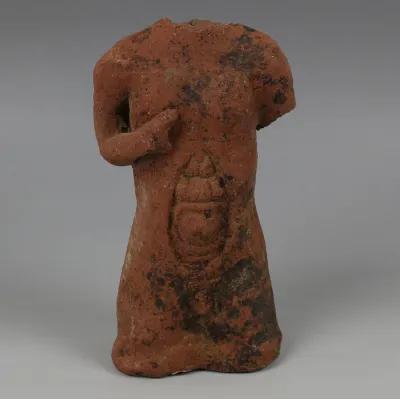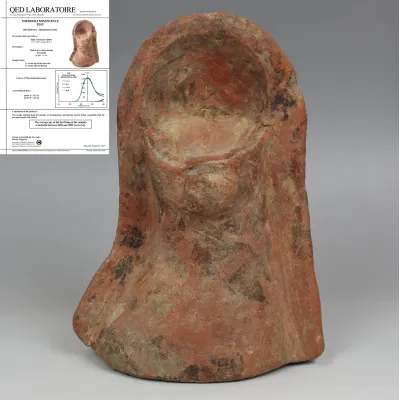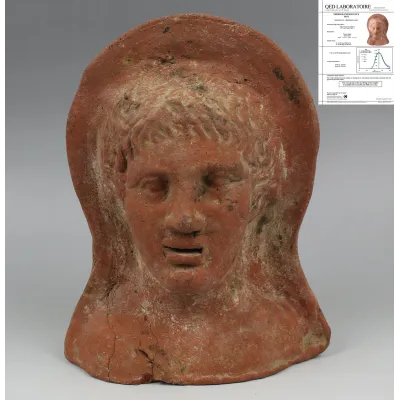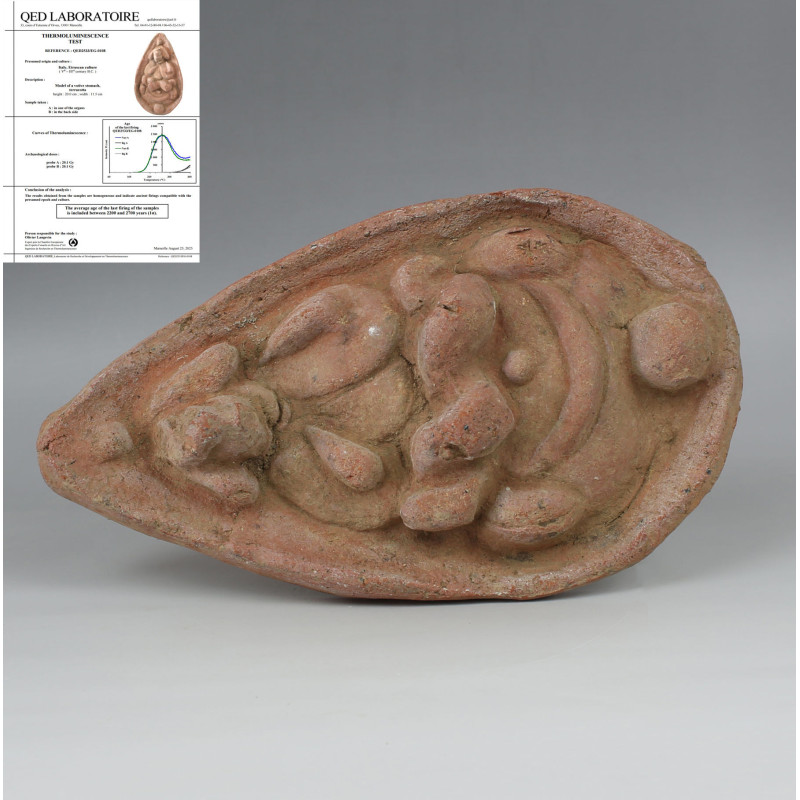
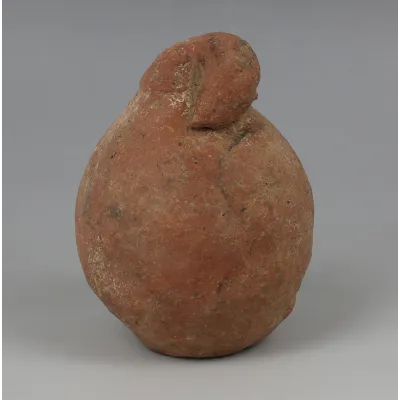
Etruscan anatomical votive model of a stomach – terracotta – 5th-4th century BC – QED2533/EG-0108 TL.
Terracotta anatomical votive model of a stomach, Etruscan culture, 5th-4th century BC, dimensions 197 × 115 mm, source condition good, with QED Laboratory thermoluminescence reference QED2533/EG-0108. The stated provenance follows the Belgian and Spanish chain documented by Your Antiquarian.
The object belongs to the large family of Etrusco-Italic anatomical ex-votos, terracotta offerings deposited in sanctuaries to request protection, thank a deity for healing or materially place the dedicant’s body within sacred space. Museum research confirms this frame: the Metropolitan Museum documents Etruscan votive heads as devotional offerings; the British Museum preserves Etrusco-Latin anatomical votives connected with religion and health; Harvard Art Museums explains the healing logic of terracotta body-part votives.
The piece should therefore not be understood as an isolated curiosity. It belongs to a precise religious system in which fired clay gives durable form to a human request. Material, scale, surface, patina, anatomy, wear and provenance must all be read as elements of a dossier.
The stomach model is especially interesting because it moves attention from the visible surface of the body to the interior. Anatomical organ votives express a religious healing logic in which the affected part, real or symbolic, is isolated and offered to the deity. It should not be overread as a precise diagnosis, but as materialization of a request concerning the belly, digestion, internal pain or bodily vitality.
Terracotta imposes a sober reading. Ancient votive clay rarely has a neutral surface: inclusions, deposits, abrasions, small losses, firing variations and archaeological patina form a set of clues. Expert description must distinguish coherent long-term material alteration from modern breaks or restorations that would need to be stated when known.
QED reference QED2533/EG-0108 is preserved as an important traceability element. Thermoluminescence does not replace typological study or provenance research, but it checks the coherence of the clay body’s last firing with the stated period.
Museum comparison is not used here to fabricate provenance, but to establish method. An anatomical votive belongs at the boundary of art history, religion, the body, healing and sanctuary production. Its intellectual force comes from this density, not from commercial emphasis.
Object: anatomical votive model of a stomach. Culture: Etruscan / Etrusco-Italic. Source dating: 5th-4th century BC. Material: terracotta. Dimensions: 197 × 115 mm. Source condition: good condition. Authenticity: QED Laboratory thermoluminescence, reference QED2533/EG-0108. Source provenance: former Belgian private collection; former Spanish antiquities dealer, 2022; former Belgian private collection, Brussels, series of Etruscan anatomical votive models and effigies. Antikarts reference: YA-13221. Internal price: EUR 2 900. Antikarts price: EUR 4 350 incl. VAT. Archived source: https://www.yourantiquarian.com/product/etruscan-anatomical-votive-model-of-a-stomach/.
The technical record must remain verifiable. Dimensions, material, dating, provenance and laboratory reference are therefore preserved exactly when present. If an organ is named by the source, it is discussed as a votive typology, not as a precise ancient medical diagnosis.
Between the 5th and 4th centuries BC, Etruscan and central Italian sanctuaries developed a remarkable practice of anatomical offerings. These objects belong to a religion of presence, healing and reciprocity. The worshipper offered an image of the body, an organ or a facial part in order to place a request within divine space.
This phenomenon is culturally important because it reveals concerns rarely visible in texts: health, pain, fertility, vulnerability and the need for protection. Anatomical votives are not mere sanctuary accessories; they are social documents showing how ancient communities thought about the body and divine intervention.
– Type: organ votive, a more intimate category than heads or visible limbs.
– Scale: 197 × 115 mm, a legible and portable module.
– Interpretation: an offering centered on the body’s interior, care and organic vulnerability.
– Material: terracotta, a privileged medium for sanctuary deposits.
– Chronology: 5th-4th century BC, classical and late classical phase of Etrusco-Italic votive practice.
– Function: anatomical votive offering, connected with protection, healing or gratitude.
– Surface: patina, deposits, erosion and handling traces should be treated as evidence.
– Traceability: Your Antiquarian source and stated collection chain; QED reference only when present in the source record.
– Caution: no sanctuary, workshop or exact medical diagnosis is invented.
The public comparisons used here are the Metropolitan Museum for Etruscan votive heads and sanctuary deposition, the British Museum for Etrusco-Latin anatomical votives associated with religion and health, and Harvard Art Museums for the healing logic of terracotta body-part offerings. These sources do not prove the provenance of the Antikarts object; they establish the cultural corpus in which it must be read.
The Your Antiquarian source supplies the object-specific data: title, material, period, dimensions, condition, provenance, laboratory reference when stated and source price. Antikarts combines those data with museum parallels to build a defensible notice in which every claim is tied either to the source, to a public corpus or to cautious typological observation.
This stomach model has strong anthropological value: it shows that sanctuaries received not only faces or limbs, but also images of organs, revealing an ancient concern with the interior body.
The value is not only age. It is the ability of the object to explain a human practice: offering an image of the body so that divine power might act upon that body. This anthropological density gives Etruscan votives a strength beyond purely decorative objects. NB: Display elements visible in photographs are not included unless otherwise stated. Certificates and reports are included only when expressly indicated in the object dossier.
Archaeological Identity Card
Material, chronological and cultural record for the object