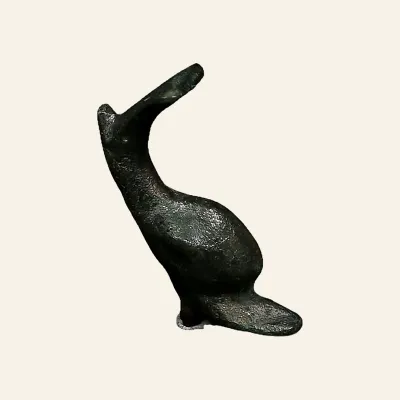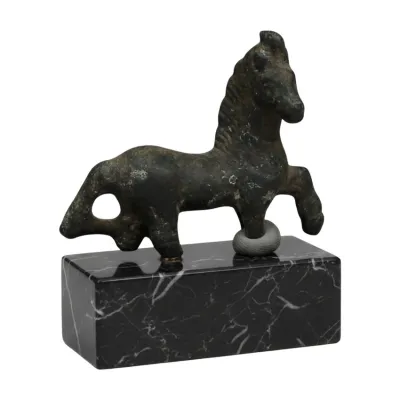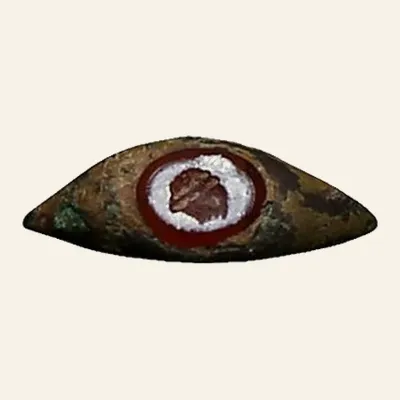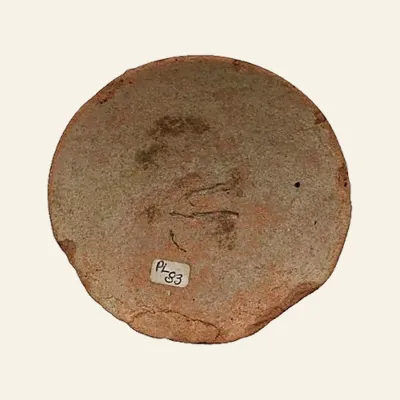
Roman bronze oil lamp with theatre-mask handle – 1st century AD.
Roman bronze oil lamp, dated to the 1st century AD, dimensions 90 × 73 × 165 mm, identified by the Your Antiquarian source as an Oil lamp with theatre mask handle. The source records good condition, provenance from a former American private collection in Connecticut, acquired during the 1980s, and a source price of EUR 2,750. The object belongs to a particularly attractive family of Roman domestic bronzes: functional lamps enriched with figurative decoration, here a handle decorated with a theatrical mask.
A Roman lamp is an everyday object, but never merely ordinary. It turns oil into light and accompanies dining, reading, work, domestic cult and nocturnal life. When made in bronze, its technical and social level changes: casting, modelling, durable metal and sculptural handle decoration separate it from common terracotta lamps. The Cleveland Museum of Art preserves a Roman bronze oil lamp dated around 50 BC-50 AD and emphasizes that such an object could serve both lighting and ornamental purposes. This double nature is essential for the Antikarts example.
The theatre mask adds a major cultural layer. The J. Paul Getty Museum documents a Roman bronze lamp in the shape of a comic mask, dated AD 75-125, and explains that masks and theatre imagery were popular motifs in Roman furnishings and interior decoration. Your Antiquarian also stresses the expressive role of the mask in ancient performance. In a domestic lamp, the mask therefore brings theatre, performance, emotion and Hellenizing taste into the private interior.
Assessment of a bronze lamp begins with structure: reservoir, filling hole, nozzle or wick area, handle, balance and signs of use. Bronze allows more durable and refined construction than terracotta, with thinner forms, sharper reliefs and sculptural handles. The measurements, 90 × 73 × 165 mm, indicate a compact domestic object with enough scale to make the theatre-mask handle visually important.
Museum comparison shows that the handle is not secondary. The British Museum preserves a Roman Imperial bronze lamp handle ornament in the form of a tragic female mask with palmette, dated about AD 50-150. This is crucial because it confirms that theatrical masks could specifically appear as bronze lamp-handle ornaments in Roman production. The Antikarts example therefore belongs to a verifiable typology, not to an arbitrary decorative association.
The bronze surface must be read as material evidence. Patina, green or brown-black oxidation, wear on reliefs, deposits in recesses and continuity of metal can inform use, preservation and age. The source simply states good condition; this notice does not invent invisible traces, but it explains what matters for inspection: metal continuity, integrity of the decoration, coherence of patina and the relation between function and figure.
Object: oil lamp with theatre-mask handle. Culture: Roman. Source dating: 1st century AD. Material: bronze. Dimensions: 90 × 73 × 165 mm. Source condition: good condition. Iconography: handle or handle decoration with theatrical mask. Function: oil lamp, domestic or ornamental lighting. Source provenance: former American private collection, Connecticut, acquired during the 1980s. Antikarts reference: YA-8493. Source price: EUR 2,750. Antikarts price: EUR 4,125 incl. VAT.
Bronze implies a casting, finishing and patination process different from mould-made terracotta lamps. Depending on its form, a bronze lamp could be suspended, set on a stand or integrated into a more refined interior. Cleveland parallels show the combination of filling hole, single nozzle and elaborate handle; the British Museum parallel confirms the theatre mask as lamp-handle ornament.
The 1st century AD corresponds to the consolidation of Roman imperial taste. Domestic objects, especially in metal, contributed to the staging of the house. The lamp was omnipresent: it made reading, dining, working, vigil and domestic ritual possible. When decorated with theatrical imagery, however, it became an object of culture as well as use.
The mask is one of the most recognizable signs of ancient performance. It fixes a role, amplifies emotion and gives the actor a stage identity. Romans, heirs and interpreters of Greek theatrical traditions, integrated mask imagery into interiors, wall painting, mosaics, vessels, fittings and lamps. A mask on a lamp can therefore be read as theatre entering daily life: the object lights the room while evoking illusion, voice, character and representation.
– Structure: bronze oil lamp, a functional object based on reservoir, filling and wick.
– Material: bronze, more durable and socially valued than ordinary terracotta.
– Dimensions: 90 × 73 × 165 mm, domestic scale with ornamental presence.
– Iconography: theatre mask on the handle, linked to comedy, tragedy and Roman interiors.
– Function: lighting, ornament and cultural signal.
– Condition: source states good condition; inspection should focus on metal continuity and patina coherence.
– Provenance: former American private collection, Connecticut, acquired in the 1980s.
– Comparisons: British Museum bronze lamp-handle ornament with tragic mask; Getty Roman lamp in the shape of a comic mask; Cleveland Roman cast bronze oil lamp.
The primary source is the Your Antiquarian record, which provides material, date, dimensions, condition and provenance. Museum research adds three points of control. The British Museum preserves a bronze lamp-handle ornament in the form of a tragic mask, Roman Imperial, AD 50-150. The Getty documents a Roman bronze lamp in the shape of a comic mask, AD 75-125, and connects theatre-mask imagery with furnishings and interiors. The Cleveland Museum preserves an early Roman bronze lamp and stresses the combination of lighting and ornament.
These parallels do not create a workshop attribution. They define a grammar: bronze lamp, light function, decorated handle or body, theatrical mask and domestic decorative culture. The Antikarts object sits within that field with its own data: 1st century AD, bronze, 90 × 73 × 165 mm, former American collection and good condition.
This lamp has greater cultural value than a simple ancient light because it unites domestic technology and visual culture. It shows how an object made to produce light could become a carrier of theatre, decor and social identity. It is highly relevant for collections of Roman bronzes, ancient domestic objects, theatre imagery and prestige furnishings.
The former American provenance, acquisition in the 1980s, bronze material, stated good condition and theatrical-mask iconography make the piece immediately legible and attractive. NB: Display elements visible in photographs are not included unless otherwise stated. This notice relies on the Your Antiquarian source and museum typological comparisons, without adding undocumented provenance.
Archaeological Identity Card
Material, chronological and cultural record for the object