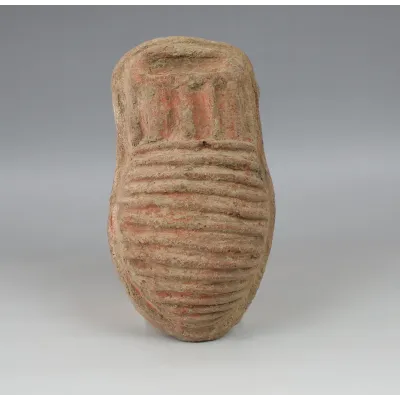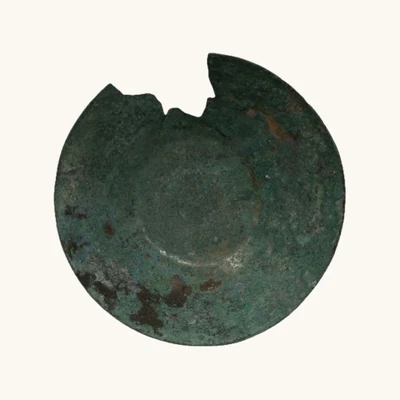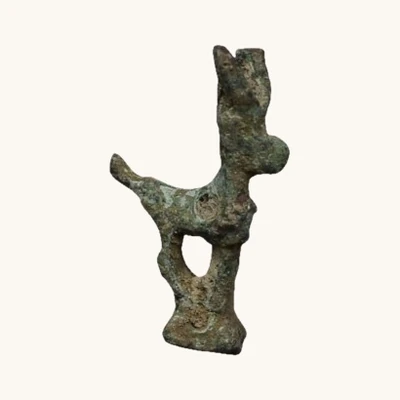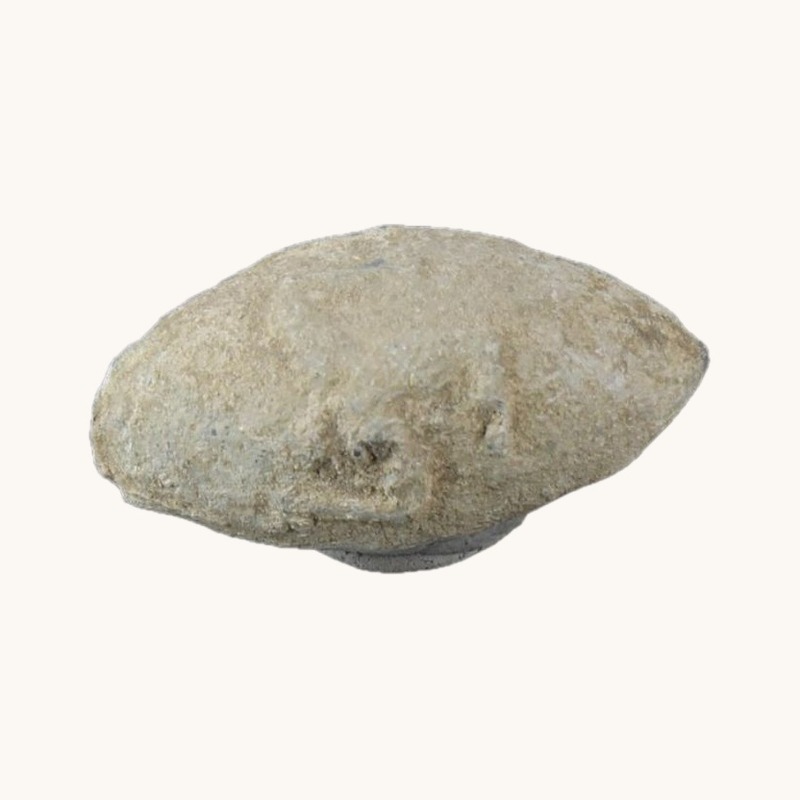
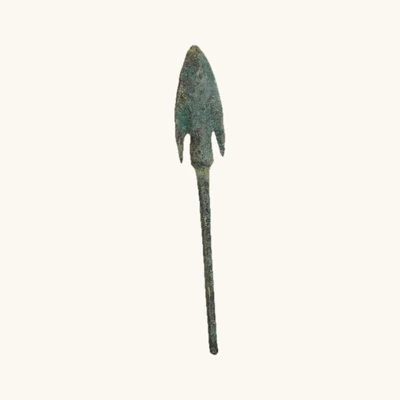
This lead sling bullet from ancient Greece, dated to the 4th century BC, constitutes exceptional testimony to Hellenic military art. Used by sphendonetes, elite slingers of Greek armies, this glans plumbea perfectly illustrates the technical and tactical ingenuity of classical Antiquity.
The authenticity of this projectile is confirmed by its morphological characteristics conforming to museum standards. The typology corresponds exactly to specimens in the British Museum, Louvre and Brooklyn Museum. The dimensions (15 × 30 mm) fall within the average of scientific corpora established by Clive Foss and international collections.
The main surface presents an apotropaic triskelion in relief, a rotating triple symbol characteristic of Hellenic glandes. This motif, softened by ancient wear, retains its legibility and evocative power, testifying to the alliance between military function and symbolic charge.
The reverse presents the homogeneous archaeological patina characteristic of centuries-long burial, enriched with natural calcareous concretions that authenticate the ancient origin of the piece.
Flan and edge
The biconical ovoid shape, obtained by casting in bivalve molds, presents pointed extremities ensuring gyroscopic stability in flight. This standardized morphology meets the ballistic requirements of Hellenic military workshops.
Material: cast lead - Dimensions: 15 × 30 mm - Period: 4th century BC - State: stable patina with enhancing wear - Decoration: apotropaic triskelion in relief
Sling bullets constituted the preferred armament of sphendonetes in 4th century BC conflicts. Denser than stone, these lead projectiles combined ballistic efficiency with psychological message, with engraved symbols serving to intimidate the adversary as much as to identify the combat unit.
This object transcends its original military function to embody the material memory of Hellenic civilization. It testifies to the fusion between technique, art and military strategy proper to Greek genius, constituting a precious fragment of ancient archaeological heritage.
Provenance: old German private collection established before 2000. Authenticity certified by Galerie Antikarts. Acquisition through specialized European auction under expert control.
Numismatic Identity Card
Technical, historical and typological documentation for the coin