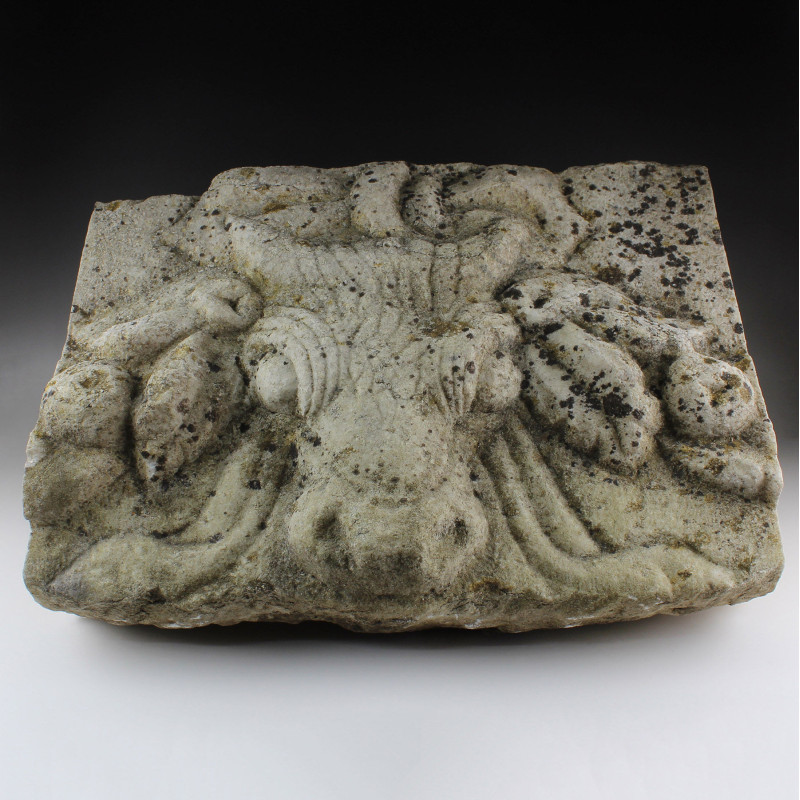
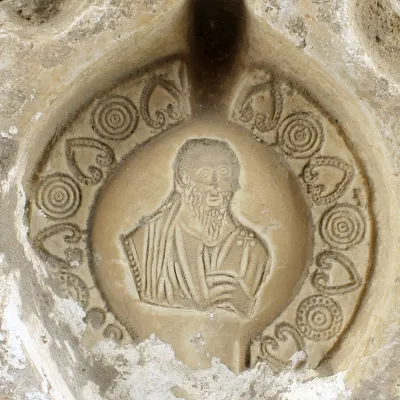
Item: Fragment of Bucranium.
Culture: Roman, possibly Turkey.
Dating: 2nd - 3rd Century A.D.
Material: Marble.
Dimensions: 290 mm x 490 mm x 280 mm.
Record prepared for Antikarts from the photographs and technical information provided by the source.
Attributions and measurements are retained as cataloguing markers, without over-interpretation.
This entry is preserved in the Antikarts Museum as a documentary reference (no price displayed).
Item: Fragment of Bucranium
Material: Marble
Culture: Roman, possibly Turkey
Period: 2nd - 3rd Century A.D
Dimensions: 290 mm x 490 mm x 280 mm
Condition: Good condition
In the Roman world, everyday objects (domestic, ritual or workshop-related) circulated widely across the Empire through specialised production centres.
Attribution: Roman, possibly Turkey. Dating indicated: 2nd - 3rd Century A.D.
Preserved as a comparison anchor within the Antikarts corpus.
Primary value lies in typology, stated dating and the associated traceability trail.
Provenance (summary): Ex German private collection, H.W., North Rhine, acquired before 1980. Bucranium (plural bucrania; Latin, from Greek βουκράνιον.
Record preserved in the Antikarts Museum as a documentary reference.
Archived source: https://www.yourantiquarian.com/product/roman-fragment-of-bucranium/.
Archaeological Identity Card
Material, chronological and cultural record for the object