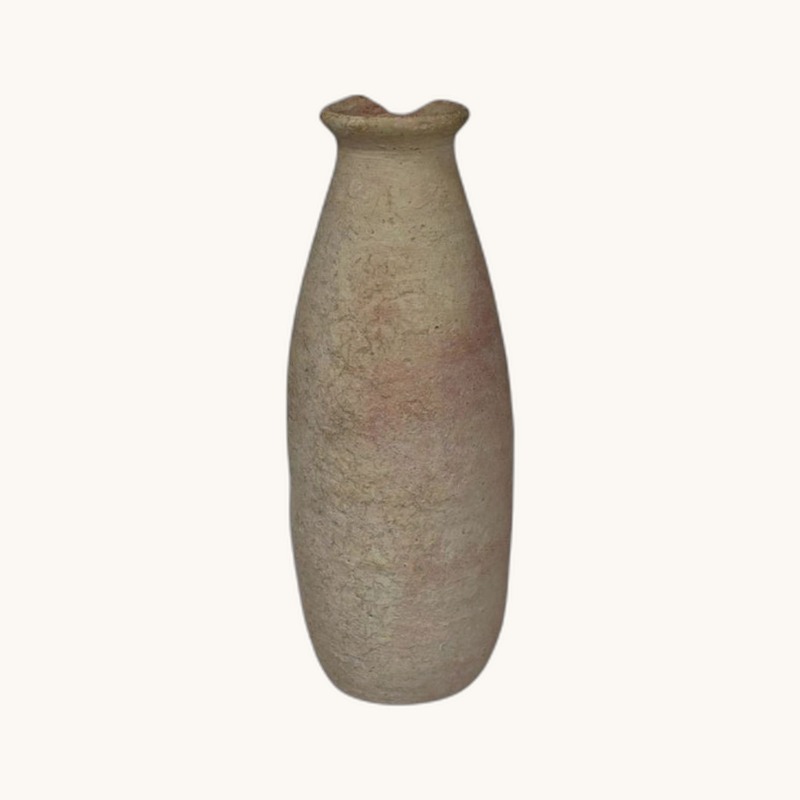
Elegant Roman jar in clear ceramic (buff ware), dated from the 1st to the 4th century AD, typical of the utilitarian and domestic production of the Roman Empire. This exceptional piece testifies to Roman ceramic craftsmanship and its diffusion throughout the Empire.
This handleless bottle in fine clear ceramic belongs to the buff/pinkish buff pottery family, characteristic of workshops from the Mediterranean world and western provinces. The regularity of the curve and precision of the turning testify to mastered pottery know-how. The fusiform shape and narrow neck indicate use for preserving oils, perfumes or precious liquids.
Not applicable for this ceramic object.
Not applicable for this ceramic object.
Flan and rim
The slightly flared straight lip presents a clean bevel, balanced by an elongated and harmonious belly. The base is rounded according to the standards of the period.
Dimensions: 19.5 × 6.8 cm. Material: clear, fine and dense paste, homogeneous oxidizing firing. Satin beige-ivory surface with authentic archaeological patina and veils due to burial. Complete state, not restored.
This typology, attested throughout the Empire between the 1st and 4th centuries, corresponds to the apogee of Roman ceramic production. These containers were used in urban houses, rural villae, thermal baths and military garrisons. The diffusion of buff ware illustrates the integrated economic network of the Empire.
This jar embodies Roman daily life and testifies to the domestic genius of an Empire that made ceramics an art of living. Through its pure form and discreet refinement, it connects the contemporary gaze to the hand of the ancient Roman potter.
Provenance: former English private collection (East Anglia), constituted between 1960 and 1980. Certificate of authenticity provided by Galerie Antikarts. Sale under expert control during specialized European auction.
Archaeological Identity Card
Material, chronological and cultural record for the object