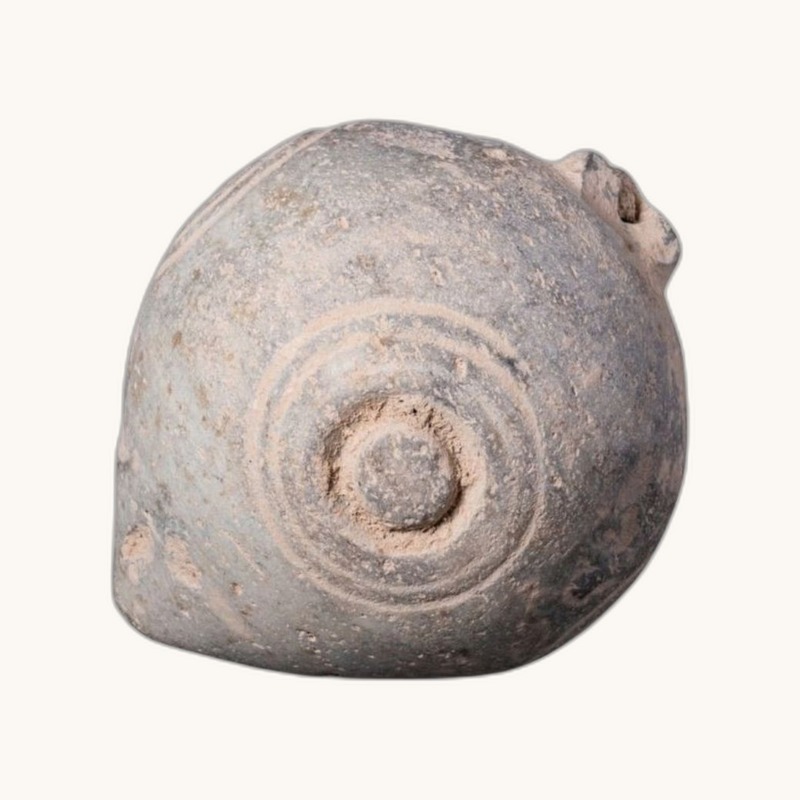
This Byzantine faience hand grenade represents exceptional testimony to the military ingenuity of the Byzantine Empire. Dating from the 9th-11th century, this artifact illustrates Byzantine technical and strategic mastery in the art of warfare.
The object perfectly corresponds to Type 3 of the Savage-Smith classification, academic reference for Byzantine-Islamic sphero-conical vessels. Recent scientific analyses (PLOS ONE 2022) confirm the pyrotechnic function through identification of hydrocarbon and nitrate residues.
Not applicable - three-dimensional object.
Not applicable - three-dimensional object.
Flan and edge
Sphero-conical body with pointed base and short circular opening. Thick walls in unglazed fired faience, stable surface with ancient archaeological patina.
Dimensions: 95 × 80 mm, weight: 330 g. Material: hard fired faience with thick walls. Decoration of concentric rings incised on the shoulder, diagnostic marker of Type 3.
These grenades were designed to contain Greek fire or flammable chemical mixtures, secret weapons of the Byzantine Empire. They testify to the fusion between craftsmanship, alchemy and military strategy.
Major document of material history, this piece symbolizes Byzantine technical power and the evolution of medieval weaponry. It finds parallels in the collections of the Metropolitan Museum, Brooklyn Museum and Royal Collection Trust.
Provenance: British private collection (1990s). Certificate of authenticity and expert report provided. Sale according to archaeological art market standards.
Archaeological Identity Card
Material, chronological and cultural record for the object