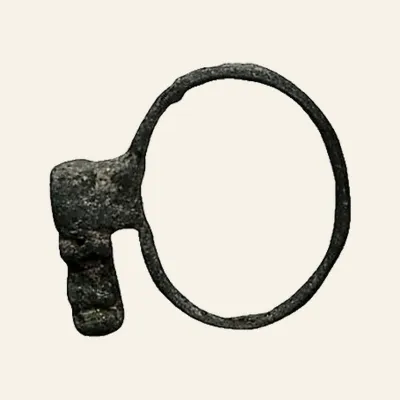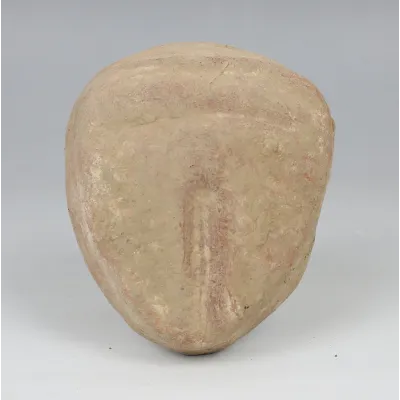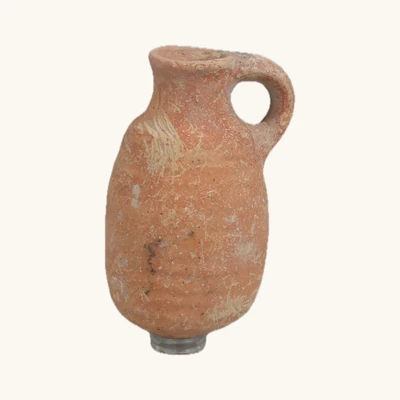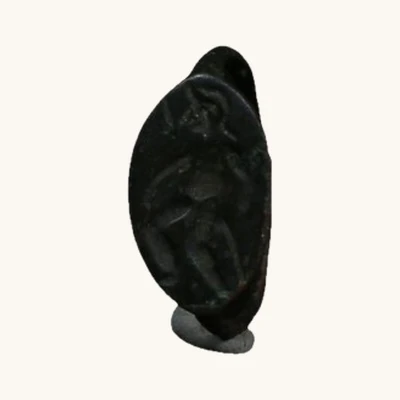
This Sumerian ceramic figurine head constitutes an exceptional testimony to Mesopotamian votive art from the 2nd millennium BC. Fragment of a larger figurine, it perfectly illustrates the aesthetic canons of the extended Sumerian tradition.
The object presents all the typological characteristics of Mesopotamian votive effigies: frontal headband structuring the hairstyle, continuous brow ridge, finely incised almond-shaped eye, straight nose and discrete mouth. This morphological configuration is museally attested and finds direct parallels at the Louvre (AO 9496) and the Metropolitan Museum of Art.
The face reveals canonical formal vocabulary with stocky oval volumetry, rounded chin and sharp nasal projection. The hairstyle is organized by a characteristic horizontal headband. The stylized features testify to an archetype rather than an individualized portrait.
The perfectly preserved dorsal circular opening documents the firing vent, a technique guaranteeing lightness and firing regularity. This technical characteristic is explicitly mentioned in Metropolitan Museum notices for analogous pieces.
Flan and edge
The granular ceramic paste reveals numerous visible mineral inclusions (reddish and dark punctuations), testifying to period workshop techniques. Smoothing and tool traces are perceptible.
Dimensions: 35 × 35 mm - Weight: 50 g - Material: fired clay with granular paste - Ochre-pink patina with chalky nuances and lighter areas - Portable votive format ideal for sanctuary deposition.
In early 2nd millennium Mesopotamia (Isin-Larsa/early Old Babylonian horizon), these votive figurines materialized the lasting presence of the faithful at the sanctuary. They constitute a timeless link between human and divine, testifying to the first religious gestures of the ancient Near East.
Through its typological accuracy, noble patina and technical coherence, this votive head represents an authentic testimony to Mesopotamian religious art. Each detail constitutes proof of authenticity and workshop trace, integrating ideally into a reference collection.
Provenance: old European collection (1960-1980) - Certificate of authenticity included - Sale under expert control - Stylistic and technical coherence attested by museum comparisons (Louvre, Metropolitan Museum).
Numismatic Identity Card
Technical, historical and typological documentation for the coin