Etruscan terracotta votive head – 5th-4th century BC – QED Laboratory certificate, Marseille 2025.
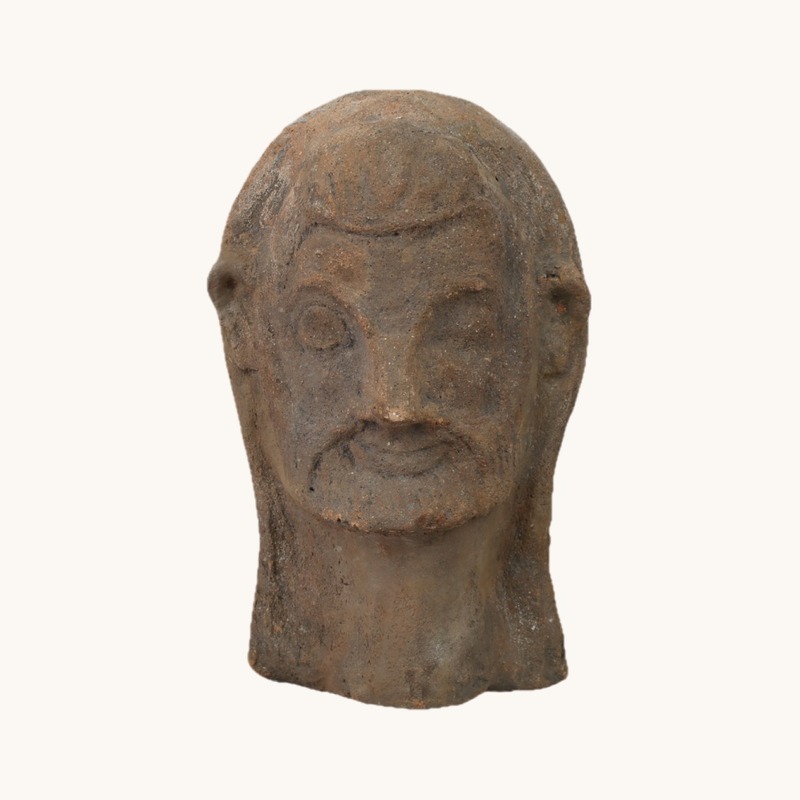
Large Etruscan terracotta votive head, dated to the 5th-4th century BC, measuring 30 cm high, 19 cm wide and 10 cm deep, authenticated by thermoluminescence at QED Laboratory under reference QED2533/EG-0103, Marseille, 2025. The dossier states a last firing compatible with an age of approximately 2,200 to 2,700 years, an oxidizing terracotta fabric, a homogeneous reddish-brown archaeological patina, mineral inclusions, siliceous concretions, natural micro-fissures and documented European provenance. With its scale, frontal presence and hollow construction with flat vented back, the object belongs to the major language of Etrusco-Italic votive offerings, in which the human body becomes an intermediary between the dedicant, the deity and the sanctuary.
This object is not a decorative head in the modern sense. In Etruscan and central Italian sanctuaries, terracotta heads, busts and anatomical parts were dedicated as ex-votos, either as requests for divine assistance, thanks for healing or substitute presences placed before the god. The Metropolitan Museum preserves Etruscan votive heads of the 4th century BC and explains their sanctuary function; the British Museum preserves Etruscan terracotta votive heads and anatomical votives classified in the fields of religion and health. These institutional parallels confirm the ritual and medical frame in which the Antikarts example should be read.
The importance of this head lies in the agreement between typology, material, scale and scientific documentation. The expressive modelling, matte ferruginous surface, technical reverse and QED TL report form a coherent group of evidence. This notice does not invent a sanctuary provenance; it situates the object within a verifiable cultural corpus: Etruscan and Italic terracotta votives used in sacred spaces between the late Archaic, Classical and early Hellenistic periods.
Expert assessment begins with manufacture. The head is described as mould-made, hollow, with a flat reverse and a circular vent. These details matter because a large terracotta votive had to dry and fire without cracking under internal pressure. The rear opening lightened the object and allowed gases to escape during firing. The less finished reverse also confirms a primarily frontal function, consistent with deposition or display in a sacred context rather than a sculpture intended for viewing in the round.
The reddish-brown surface, mineral inclusions and concretions are equally significant. An authentic votive terracotta does not normally present a perfectly smooth decorative skin; it carries traces of firing, burial, deposits and handling. The micro-fissures, ferruginous traces and matte surface described in the dossier should be read as material information, not as mere condition notes. They are evidence of long duration and archaeological coherence.
The male face preserves a strong frontal force: broad forehead, marked brow, straight slightly aquiline nose, fine mouth and stylized beard. This is not portraiture in the modern psychological sense. It is a votive image: sufficiently human to embody presence, sufficiently typological to belong to the collective language of the sanctuary. That tension between individuality and ritual series gives Etruscan votive heads their particular intensity.
Object: Etruscan terracotta votive head. Culture: Etruria / Etrusco-Italic tradition. Period: 5th-4th century BC. Material: oxidizing terracotta. Technique: mould-made hollow structure, flat reverse with vent hole. Dimensions: H. 30 cm, W. 19 cm, D. 10 cm. Surface: homogeneous reddish-brown archaeological patina, matte aspect, mineral inclusions, ferruginous deposits, siliceous concretions and natural micro-fissures. Authenticity: QED Laboratory certificate, Marseille, 2025, reference QED2533/EG-0103, thermoluminescence test indicating a last firing about 2,200 to 2,700 years ago. Stated provenance: documented European provenance. Antikarts reference: YA. Internal price: EUR 3,300. Antikarts price: EUR 6,885 incl. VAT.
Thermoluminescence is particularly relevant for this object because it concerns the clay body and its last firing. It does not replace stylistic assessment, surface examination or provenance study, but it provides an important scientific layer of chronological coherence. In a collector’s dossier, the exact laboratory reference must be preserved because it separates documented proof from historical interpretation.
Between the 5th and 4th centuries BC, Etruscan and central Italian sanctuaries formed a dense religious landscape. Devotees deposited offerings in bronze, stone and terracotta. Anatomical votives, heads, busts and figurines translated human need into durable material form. Offering an image of the body, or part of the body, meant placing a request, gratitude or protective presence within sacred space.
Votive heads differ from isolated anatomical parts because the face carries the entire identity of the dedicant without necessarily being an exact portrait. It is a human presence before the deity. Collective deposits from sanctuaries show that these objects were produced in quantity, yet repetition does not reduce their value; it reveals a structured religious system in which clay acted as a lasting form of votive speech.
– General organization: large frontal votive head, intended for primary reading from the front.
– Technique: hollow mould-made terracotta with flat vented reverse, coherent with ancient manufacture and firing.
– Face: broad forehead, marked brow, slightly aquiline nose, fine mouth and stylized beard; expressive yet typological.
– Hair: incised locks around the nape, treated synthetically as part of a ritual image rather than a naturalistic portrait.
– Surface: reddish-brown patina, ferruginous deposits and concretions, without artificial gloss.
– Scientific proof: QED TL reference QED2533/EG-0103.
– Typological coherence: Etruscan / Etrusco-Italic terracotta votive comparable in function to sanctuary deposits documented by public collections.
The comparisons used here are methodological. The Metropolitan Museum preserves Etruscan terracotta votive heads and situates them within devotional practice. The British Museum preserves Etruscan votive heads and an Etrusco-Latin terracotta anatomical torso associated with religion and medicine. Harvard Art Museums, through an anatomical terracotta eye, explains the healing logic of votive body parts and their grouped deposition near sanctuaries.
These parallels do not assert the same workshop or provenance. They establish the correct interpretive field: the Antikarts object belongs to the world of terracotta ex-votos, where representation of the body is a ritual act. The value of the dossier is therefore to separate the data of the individual object, the QED scientific proof and the museum parallels that explain its cultural function.
This votive head is powerful because it brings together human presence, sacred medicine and sanctuary materiality. It speaks to collectors of Etruscan art, but also to those interested in the history of religion, the body and ancient healing. Its importance is not only aesthetic; it preserves a form of relationship between an ancient individual and a divine power.
The scale of 30 cm, the legible technical reverse, the coherent archaeological surface and the referenced QED TL report give the piece strong collecting value. It can stand within a collection devoted to Etruria, Italic cults, ex-votos, the history of medicine or terracotta sculpture. NB: Display elements visible in photographs are not included unless otherwise stated. The QED certificate mentioned is included when supplied with the sale dossier.
Archaeological Identity Card
Material, chronological and cultural record for the object