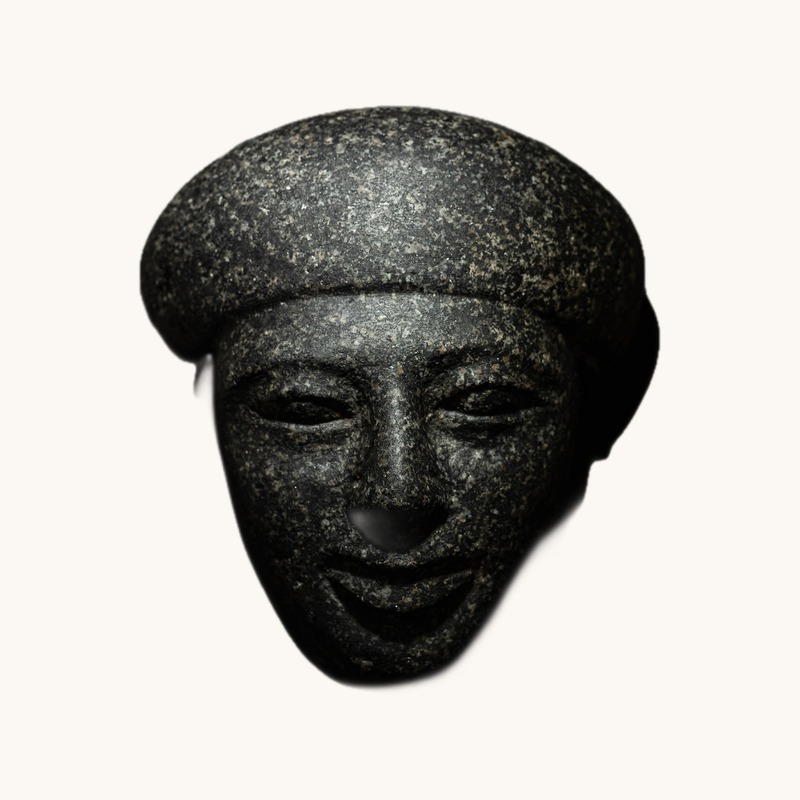
Exceptional Egyptian funerary mask in granodiorite, dating from the Late Period (664-332 BC), depicting a youthful face with a "cap-style" wig. This prestigious stone work showcases the artistic refinement of the Saite period.
Careful examination under ×10 magnification reveals masterful modeling consistent with late workshops: supple brow ridges, taut upper eyelid, incised inner canthus, straight nasal ridge, outlined lips with discrete smile. Homogeneous ancient patina varies by zones with sustained polish on main reliefs.
Idealized face with youthful tonality presenting paired almond-shaped eyes, rectilinear nasal ridge and clearly outlined lips, characteristic of the Saite repertoire. The frontal edge of the wig is highlighted by a continuous incised groove.
Ancient crystalline fracture revealing authentic mineralogical structure with quartz/feldspar sparkles and biotite platelets, material signature of ancient breakage without modern intervention.
Flan and edge
"Cap-style" wig with regular volume showing ancient blunted bruising on the postero-right quadrant, perfectly stabilized and homogeneous with general patina.
Material: fine-grained granodiorite. Dimensions: 16 × 12 cm. Condition: satin patina, coherent historical micro-abrasions.
During the Late Period, lithic masks complemented dignitaries' sarcophagi. The choice of hard stones signified permanence and social rank. Codified iconography aimed at eternal transfiguration according to refined Saite aesthetics.
Work of museum presence emblematic of late funerary canon, carved in prestigious stone. Reference piece for demanding Egyptian art collections, accessible to lovers of authentic lapidary iconography.
Documented provenance with French export license n° 227349, negative AIAD/Interpol search, geological report Dr R. L. Bonewitz n° TL05402, and nominative authenticity certificate.
Archaeological Identity Card
Material, chronological and cultural record for the object