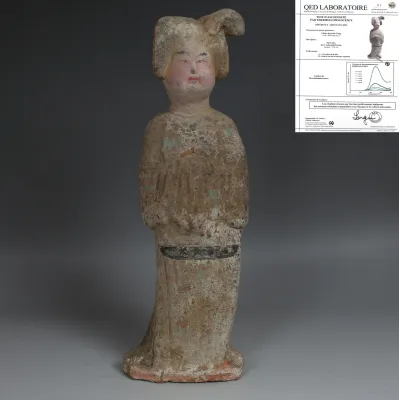
Chinese ox-cart diorama – Northern Qi dynasty, 550–577 AD – Kotalla TL
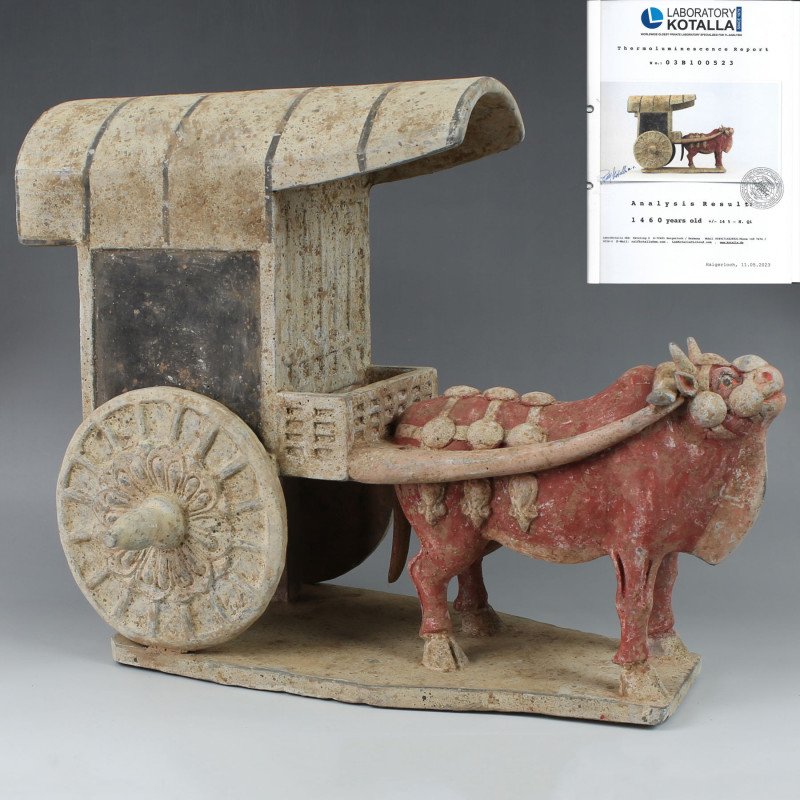
Important Chinese funerary ceramic diorama identified by the Your Antiquarian source as an Ox cart diorama of the Northern Qi dynasty, dated 550–577 AD, dimensions 305 × 155 × 393 mm. The source states good condition, a thermoluminescence test by Laboratory Kotalla, reference 03B100523, an old certificate of authenticity from a Dutch gallery and provenance from a Belgian private collection acquired before the 1990s. These elements place the piece within a highly significant category: mingqi, funerary objects intended to accompany the deceased into the afterlife and recreate, in miniature, an environment of status, service and protection.
The Northern Qi dynasty, though short-lived, was one of the decisive moments of 6th-century Chinese material culture. Funerary workshops developed forms connected with aristocracy, exchange between Xianbei and Han traditions, mobility, procession and tomb imagery. The ox cart is not a picturesque detail: in elite culture, the vehicle signals rank, ceremonial movement and social position. The diorama therefore transforms an aristocratic reality into funerary furniture.
The interest of this piece begins with its character as an ensemble. A funerary diorama is more complex than a single figure: it combines vehicle, animal, implied social presence and spatial organization. In mingqi culture this narrative dimension is essential. The object does not merely represent an ox and cart; it gives material form to service, mobility and rank in the afterlife.
The funerary ceramics of the Northern dynasties operate through substitution. Since the Han, mingqi gradually replaced real goods or sacrifices with terracotta equivalents. The Metropolitan Museum explains that such “spirit utensils” were made to serve the deceased in the afterlife and were often produced in workshops for families preparing burials. The Antikarts diorama belongs directly to this tradition.
The Kotalla thermoluminescence test is a strong traceability point. For ancient ceramic, TL does not prove every aspect of an object’s history, but it verifies the last firing of the clay body and helps test chronological coherence with the stated period. Reference 03B100523 must therefore remain central in the dossier, alongside the old Dutch gallery certificate and Belgian provenance before the 1990s.
Object: ox-cart diorama. Culture: China, Northern Qi dynasty. Source dating: 550–577 AD. Material: ceramic / pottery. Dimensions: 305 × 155 × 393 mm. Source condition: good condition. Authenticity: thermoluminescence test by Laboratory Kotalla, reference 03B100523. Documentation: old certificate of authenticity from a Dutch gallery. Source provenance: Belgian private collection, acquired before the 1990s. Antikarts reference: YA-13966. Source price: EUR 4,600. Antikarts price: EUR 6,900 incl. VAT.
The Northern Qi dynasty ruled from 550 to 577 in northern China. It was politically unstable yet culturally productive, marked by Xianbei traditions, Han administration, aristocratic practice and Buddhist patronage. This convergence created a visual world in which funerary objects became mirrors of social identity.
In elite tombs, ceramic models did more than decorate the space: they organized the afterlife. Officials, servants, animals, vehicles, guardians and musicians represented a miniaturized society. The ox cart belongs to this logic of provision: it grants the deceased a vehicle, mobility and social dignity in the funerary world.
The primary source is the Your Antiquarian record for the Chinese Ox cart diorama, which provides material, dating, dimensions, TL, certificate and provenance. Museum comparisons confirm the cultural setting: the Metropolitan Museum preserves Northern Wei–Northern Qi tomb pottery and explains that mingqi served the deceased in the afterlife. Its study Cultural Convergence in the Northern Qi Period also discusses the social role of ox-drawn carriages and their decoration according to rank.
The Cleveland Museum of Art preserves Northern Qi works, including funerary platform sections and Xiangtangshan-related sculpture, documenting the sophistication of 6th-century material and religious culture. These are contextual parallels, not provenance claims. They provide the historical frame in which the Antikarts diorama becomes legible: funerary world, aristocratic rank, mobility and miniaturized representation.
This diorama has greater cultural interest than an isolated figure because it combines form, funerary function and social rank. It opens the tomb as an organized space: the deceased is accompanied not only by symbols, but by material means of aristocratic existence transferred into the afterlife.
NB: Presentation elements visible in photographs are not included unless otherwise stated. This notice creates no additional provenance; it relies on the commercial source, stated TL test, certificate and contextual museum comparisons.
Archaeological Identity Card
Material, chronological and cultural record for the object