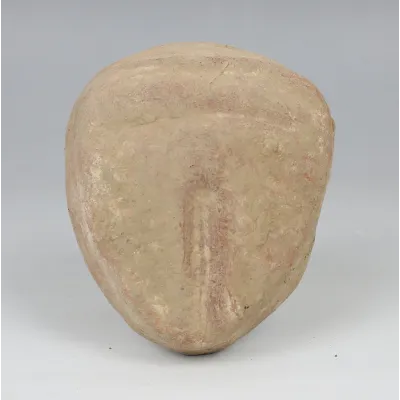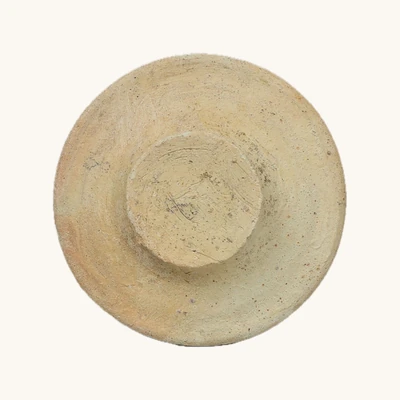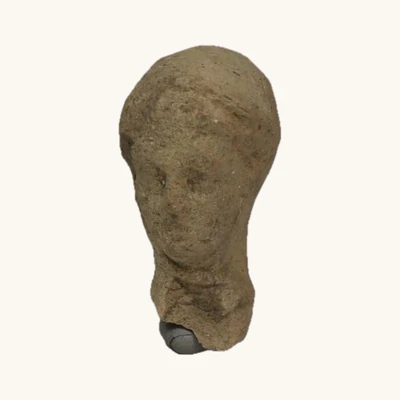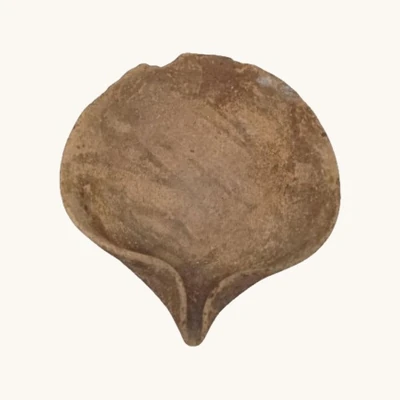
This lead sling bullet from the 4th century BC represents an exceptional testimony to ancient Greek weaponry, combining ballistic efficiency and psychological dimension through its inscription "ΣIA".
This specimen belongs to the tradition of inscribed molded projectiles used by Greek slingers (sphendonètes). Its typology perfectly matches examples preserved at the British Museum and Metropolitan Museum of Art, confirming its authenticity.
The inscription "ΣIA" is molded in relief according to canonical Greek technique. This brief legend fits into the register of military messages, probably an abbreviation of a name or tactical formula.
Smooth surface characteristic of bullets molded in bivalve matrices.
Flan and edge
Biconical (almond) shape optimizing aerodynamics, made by direct casting in a mold. Homogeneous surface testifying to military-grade lead quality.
Dimensions and weight conform to Greek military standards (31-32 mm, 37-40 g), guaranteeing optimal range of approximately 400 meters with precision.
Slingers constituted an essential component of Greek light troops. These lead projectiles, denser than stone, offered decisive ballistic superiority and served as psychological weapons through their provocative inscriptions.
Beyond its military function, this bullet testifies to the fusion of technique, language and strategy in Greek thought. It illustrates how weapons became message vectors and expressions of civic identity.
Provenance: former German private collection. Supplied with certificate of authenticity. Typology validated by comparison with British Museum and Metropolitan Museum of Art collections.
Numismatic Identity Card
Technical, historical and typological documentation for the coin